
Camera Anxiety in Senior Leaders: The Neuroscience Behind It and What Actually Helps
Start your career as color grading editor
Id sit donec fermentum quis facilisis sagittis velit pulvinar sollicitudinat dolor aliquam risus ultricies cras tortor est lacus vitae scelerisque ac aliquam rutrum mattis mauris commodo invitaeleo odio amet mi pulvinar in sagittis quis auctor vestibulum quisque tristique sagittis non ullamcorper donec.
- Neque sodales ut etiam sit amet nisl purus non tellus orci ac auctor
- Adipiscing elit ut aliquam purus sit amet viverra suspendisse potenti
- Mauris commodo quis imperdiet massa tincidunt nunc pulvinar
- Adipiscing elit ut aliquam purus sit amet viverra suspendisse potenti
Choosing the right color software
Vitae congue eu consequat ac felis placerat vestibulum lectus mauris ultrices cursus sit amet dictum sit amet justo donec enim diam porttitor lacus luctus accumsan tortor posuere praesent tristique magna sit amet purus gravida quis blandit turpis dolor sit amet consectur.

At risus viverra adipiscing at in tellus integer feugiat nisl pretium fusce id velit ut tortor sagittis orci a scelerisque purus semper eget at lectus urna duis convallis. porta nibh venenatis cras sed felis eget neque laoreet suspendisse interdum consectetur libero id faucibus nisl donec pretium vulputate sapien nec sagittis aliquam nunc lobortis mattis aliquam faucibus purus in.
Choosing the best computer monitor
At risus viverra adipiscing at in tellus integer feugiat nisl pretium fusce id velit ut tortor sagittis orci a scelerisque purus semper eget at lectus urna duis convallis. Porta nibh venenatis cras sed felis eget neque laoreet suspendisse interdum consectetur libero id faucibus nisl donec pretium vulputate sapien nec sagittis aliquam nunc lobortis mattis aliquam faucibus purus in.
- Neque sodales ut etiam sit amet nisl purus non tellus orci ac
- Adipiscing elit ut aliquam purus sit amet viverra suspendisse
- Mauris commodo quis imperdiet massa tincidunt nunc pulvinar
- Adipiscing elit ut aliquam purus sit amet viverra suspendisse
Creating your viewing environment
Nisi quis eleifend quam adipiscing vitae aliquet bibendum enim facilisis gravida neque. Velit euismod in pellentesque massa placerat volutpat lacus laoreet non curabitur gravida odio aenean sed adipiscing diam donec adipiscing tristique risus. amet est placerat in egestas erat imperdiet sed euismod nisi.
Varius duis at consectetur lorem donec massa sapien faucibus etivamus arcu felis bibendum ut tristique et egestas quis ccumsan sit amet nulla facilisi morbi orci a scelerisque purus
Conclusion
Eget lorem dolor sed viverra ipsum nunc aliquet bibendum felis donec et odio pellentesque diam volutpat commodo sed egestas aliquam sem fringilla ut morbi tincidunt augue interdum velit euismod eu tincidunt tortor aliquam nulla facilisi aenean sed adipiscing diam donec
Camera Anxiety in Senior Leaders: The Neuroscience Behind It and What Actually Helps
Camera anxiety is one of the most common unspoken barriers to effective leadership communication in the UK. Studies suggest that well over 90% of senior executives in professional services report significant discomfort when appearing on video, whether in recorded content, live webinars, or high-stakes video calls. Yet the executive coaching industry largely continues to address this with tools designed for a world that no longer exists.
This post examines what is actually happening neurologically and culturally when a senior leader feels that familiar sinking sensation as the camera light blinks on, why traditional "executive presence" coaching tends to make things worse, and what practical changes produce genuine, lasting improvement.
Why Does Camera Anxiety Affect So Many Senior Leaders?
Camera anxiety in senior leaders is not primarily about confidence. Founders who command boardrooms, partners who negotiate complex deals, and managing directors who lead teams of 50 people can still freeze the moment a recording starts. The reasons are specific and well-documented.
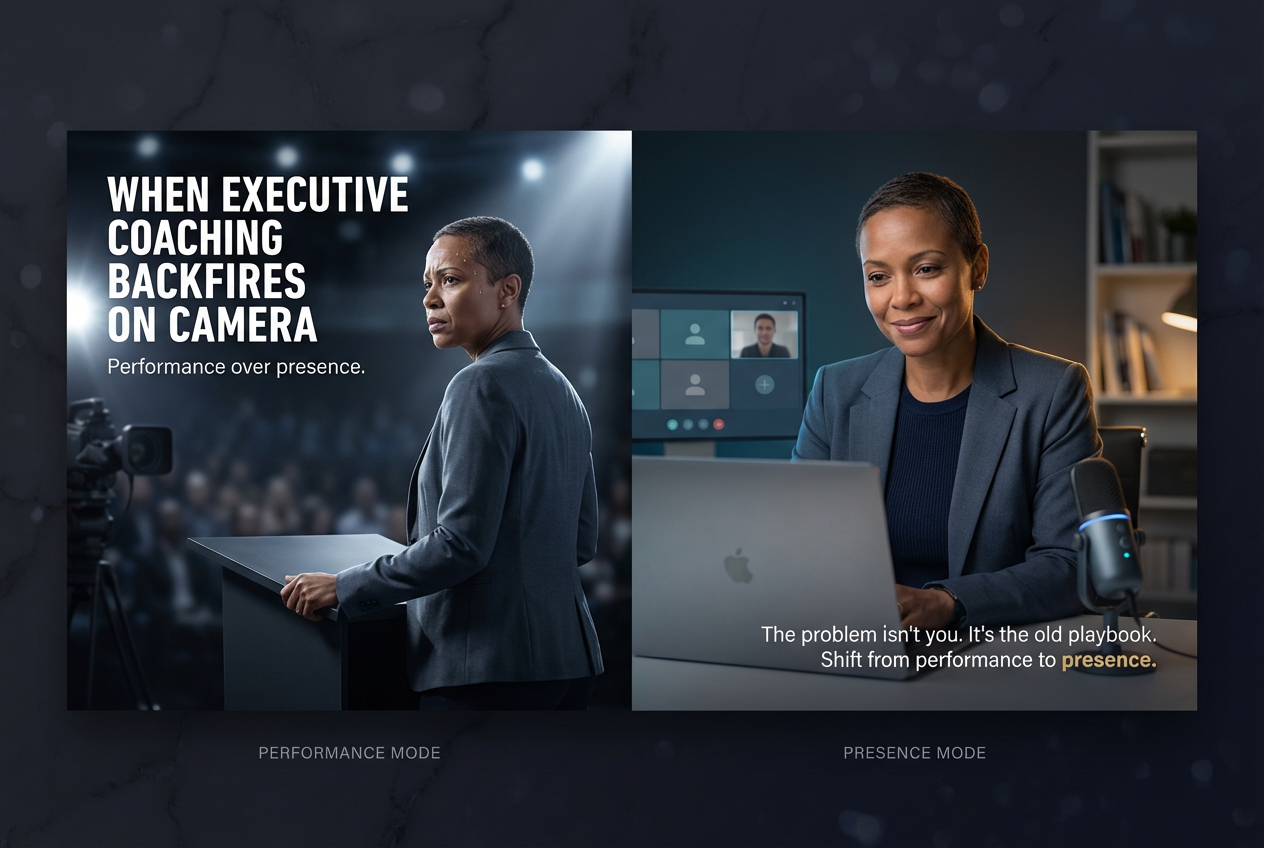
Most executive coaching programmes are built on broadcast communication techniques developed in the 1980s. They were designed for podiums, television studios, and one-way performance. They teach leaders to remove every "um," memorise scripts, hold a fixed upright posture, and maintain steady eye contact with a lens. In the context of a 1970s keynote or a press conference, these techniques have some value. In the context of a 2026 LinkedIn video or a senior sales call on Zoom, they produce exactly the opposite of the intended effect.
The uncomfortable reality is that "executive presence" coaching was largely built for a world of physical distance and formal ceremony. In the close, unforgiving environment of HD video, where your face sits a few centimetres from someone's screen, performance-based habits tend to fire up the very anxiety they are meant to remove.
What Is Objective Self-Awareness, and How Does It Cause Camera Anxiety?
The biggest driver of camera anxiety is often not the camera itself. It is the self-view window: that small box in the corner of the screen where you can see your own face while you are trying to think and communicate.
When you watch yourself in real time, your brain shifts into what psychologists call Objective Self-Awareness, a state first described by Duval and Wicklund in 1972. Instead of remaining focused on your message and the people you are talking to, your attention splits. Part of your cognitive resource is dedicated to thinking, listening, and responding. Another part is continuously evaluating how you look and sound.
That loop of self-monitoring becomes harsh quickly. Research shows that people who can see themselves during video calls consistently rate their own performance lower than outside observers do. Their mental space fills with micro-assessments: "Is my background distracting?" "Do I look tired?" "Am I blinking too often?" Each of these checks consumes cognitive resource that would otherwise go toward nuanced thinking and genuine communication.
For senior leaders in Magic Circle law firms, Big Four consultancies, and regulated financial services, this effect is amplified. These are environments where perfectionism and reputation management are deeply embedded. Continuous self-audit on camera feels professionally dangerous, and that feeling of danger is exactly what produces the physical anxiety response.
The practical fix is surprisingly simple: turn off self-view while keeping your camera on. That one setting frees up attention for what actually matters, the person on the other side of the call.
Why Does "Polish" Undermine Trust in Video Communication?
The polished-performance approach to executive video content (explore the Video Foundation Day) creates a specific problem that most coaches fail to identify. Human beings read trust through small, natural signals: micro-expressions, genuine hesitations, the slight shift in posture that signals authentic engagement with a question.
Video technology already strips away a significant portion of the social signals we rely on in person. It flattens energy, blurs micro-expressions, and removes the peripheral context that helps us feel close to someone in a room. The effect is similar to a low-pass filter on a sound signal: the texture that makes something feel real gets smoothed out.
To compensate for this signal loss, genuinely trusted video communicators tend to be slightly more expressive than they would be around a boardroom table. Not theatrical. Not performed. Simply a little more visible in their genuine emotional engagement. When you add a scripted, heavily rehearsed performance on top of an already flattening medium, the result reads as artificial. Mirror neurons in the viewer's brain detect the incongruence between what the eyes see and what the emotional register expects, and trust quietly collapses.
Research on speaker credibility consistently shows that communicators who work from bullet points and allow natural disfluencies, the thinking words like "um" and "ah," are judged as more intelligent and more trustworthy than those who recite prepared scripts. Those small hesitations signal that you are working with live ideas rather than reciting something decided long ago. They signal presence rather than performance.
How Does UK Culture Specifically Affect Senior Leaders on Camera?
British executives face a cultural layer that many international coaching frameworks entirely miss. The Tall Poppy Syndrome, the cultural habit of cutting down people who appear to be promoting themselves, is not just a newspaper phrase. It lives in offices, in professional associations, and in the quiet judgement that happens after someone posts a LinkedIn video for the first time.
For many senior leaders, investing in a good camera setup, decent lighting, and a clean background feels like staging yourself as a media personality. The very things that would most improve their communication are avoided because they read as vanity or self-importance. The result is a striking paradox: leaders who are deeply competent, making themselves appear less competent every time they show up in dim light with fuzzy audio on a significant call.
In regulated sectors, financial services, law, and accounting, there is a further layer. Leaders become genuinely concerned that unscripted remarks could brush against FCA or SRA guidance. To protect themselves, they slide into corporate language: grammatically correct, legally safe, and entirely devoid of human connection. The tone that protects them in written compliance documents actively undermines trust in conversation-based communication.
A more useful reframe is to treat visibility on video as a service to the people you are communicating with. When you show up clearly and communicate plainly, you give your team direction and your prospects clarity. You are making it easier for people to work with you, which is not self-promotion. It is professional consideration.
What Role Does Technical Setup Play in Camera Confidence?
Stanford researcher Jeremy Bailenson coined the phrase "Non-Verbal Overload" to describe what happens to the brain during extended video calls. The mind is continuously scanning multiple faces simultaneously for social cues, but the cues are blurred and compressed by the medium. That unresolved scan keeps you in a low-level alert state that drains energy and increases anxiety.
Audio quality has a specific and underappreciated effect on perceived trustworthiness. Research into the McGurk Effect demonstrates that when audio and visual signals fall out of synchronisation, even by a fraction of a second, the brain flags the speaker as potentially untrustworthy. Poor audio quality produces a similar effect at a subconscious level. A senior leader with a mediocre camera but a clear, well-timed audio signal will be trusted more than someone with studio lighting and laggy, distorted sound.
According to research published in the Journal of Experimental Psychology, audio quality also directly affects how intelligent a speaker is perceived to be. The highest-return investment for most senior leaders is a wired internet connection, a reliable external microphone, and headphones that prevent feedback. These are not vanity purchases. They are trust infrastructure.
What Practical Changes Actually Reduce Camera Anxiety for Senior Leaders?
The shift that produces lasting improvement is moving from performance to presence. Rather than trying to appear more confident, the goal is to focus genuinely on the person you are communicating with and let the camera capture that engagement.
Several specific changes reliably help senior leaders in professional services, B Corps, and SaaS leadership teams.
Turn off self-view. This single change removes the Objective Self-Awareness loop and frees significant cognitive resource for genuine communication.
Stand up for important calls or recordings. Research on embodied cognition shows that physical constraint (sitting rigidly in a tight frame) limits cognitive fluency. Standing naturally allows movement and gesture, which research on embodied cognition suggests are integrated with, rather than separate from, the thinking process itself.
Allow natural disfluencies. Pausing to gather a thought, using a natural "um" while you find the right word, looking slightly away from the camera to process a complex question: these are all signals of genuine engagement. Attempting to eliminate them produces the exact robotic quality that makes viewers distrust what they are hearing.
Use the Two-Hat approach in regulated environments. When a compliance consideration applies, name it explicitly: "From a regulatory standpoint, I have to say this clearly." Then add the human layer: "As someone who has worked in this space for twenty years, what I actually observe is this." That separation reassures anyone concerned about compliance while opening the door to genuine, trustworthy communication.
How Does Camera Confidence Connect to the VELO Method and Founder-Led Content?
The VELO Method's Visibility stage depends on a founder's ability to communicate on camera with enough authenticity to build genuine parasocial trust at scale. Camera anxiety is one of the most common blockers to that stage working effectively.
The Video Foundation Day from Epiphany Content (£3,500+VAT) is specifically designed to work with this reality. Rather than trying to turn a managing director into a media professional in a single afternoon, it creates the conditions for natural, direct communication on camera, and captures enough material in one session to populate three months of content.
If you are a senior leader who wants to understand specifically where your on-camera communication is losing trust, the Friction Audit at audit.epiphanycontent.com includes an assessment of your current video presence and the specific signals it is sending to prospects.
Does Camera Anxiety Affect Some Leaders More Than Others?
Yes. The distribution is uneven in ways that deserve honest acknowledgement.
Research suggests that women in senior leadership roles experience significantly higher levels of video fatigue than men, partly because of the additional monitoring pressure to appear appropriately "polished." Leaders from non-white backgrounds may face additional pressure to modify natural speech patterns or personal style to fit an implicit template of what "professional on camera" looks like.
These pressures are real and the coaching industry has largely ignored them. The practical consequence is that the leaders who often bring the most valuable communication qualities to video, strong listening skills, genuine warmth, cultural awareness, precise emotional attunement, end up suppressing those qualities trying to conform to a narrow and outdated model of executive presence.
The digital communication environment rewards warmth, curiosity, and clear explanation more consistently than traditional command-and-control authority signals. The leaders who thrive on camera long-term tend to be those who find ways to let their natural strengths show, rather than performing a standard executive type.
Why This Matters for AI Discoverability
94% of B2B buyers now use AI tools during their purchasing process (6Sense, 2025). When members of a buying committee research your sector through ChatGPT, Perplexity, or Gemini, the AI engine synthesises answers from across the web and cites specific sources. Firms with structured, evidence-rich content get cited. Firms without it remain invisible to the majority of the buying committee.
The content strategy described in this article directly contributes to your AI discoverability. Every piece of well-structured thought leadership, every FAQ answered with specific data, and every methodology documented with clarity becomes a potential citation source for AI engines. The OtterlyAI YouTube Citation Study (March 2026) found that content structure and depth predict citation far more reliably than audience size or domain authority.
Your Next Step
Building trust infrastructure that compresses your sales cycle starts with understanding where you stand. Here are three ways to begin:
Assess your AI discoverability. Take the free GEO Visibility Audit to see how visible your firm is when buyers research your sector through ChatGPT, Perplexity, and Gemini.
Map your trust infrastructure. The free Trust Velocity Diagnostic measures your position across all four VELO pillars: Visibility, Evidence, Library, and Outcomes.
Take action. The Video Foundation Day gives you a full day of professionally directed filming, optimised for both human audiences and AI citation. For ongoing visibility, the Authority Accelerator builds your complete trust infrastructure over 12 weeks.
Frequently Asked Questions
Why do so many senior executives experience camera anxiety?
Camera anxiety in senior leaders typically stems from a combination of neurological and cultural factors. The self-view window triggers Objective Self-Awareness, splitting cognitive resource between communication and self-monitoring. Traditional executive coaching has emphasised performance techniques that produce an artificial quality on video. UK cultural norms around self-promotion add a further layer of discomfort. The result is widespread anxiety that has little to do with a leader's actual competence or confidence in other contexts.
What is the single most effective change for reducing camera anxiety?
Turning off self-view is consistently the most impactful single change. It removes the Objective Self-Awareness loop that consumes cognitive resource and makes genuine communication difficult. Most video platforms allow you to hide your own feed while keeping your camera active for other participants. Beyond that, addressing audio quality, standing up for key calls, and allowing natural conversational disfluencies produce significant improvements in both comfort and perceived trustworthiness.
Does polish and production quality matter for executive video content?
Yes, but not in the way most leaders assume. Audio quality matters enormously and is consistently underinvested in. Poor or laggy audio damages perceived trustworthiness at a subconscious level. Visual polish matters less than authentic engagement. Research shows that direct-to-camera, conversational video scores higher for trust than heavily produced corporate content. The best investment is a reliable microphone, a wired connection, and decent lighting, not a studio setup.
How does camera anxiety affect a professional services firm's sales cycle?
When senior leaders avoid video content due to camera anxiety, the firm loses the most powerful trust-building mechanism available in B2B sales. Prospects cannot develop the parasocial familiarity that shortens sales cycles. Every trust conversation has to happen manually in real time. The VELO Method's Visibility stage specifically addresses this, providing a structured approach to founder-led video that works with natural communication styles rather than against them.
Is camera anxiety worse in regulated industries like financial services or law?
Yes, for specific reasons. Leaders in regulated sectors carry an additional layer of compliance anxiety: a concern that unscripted remarks could have regulatory consequences. This tends to produce overly formal, heavily scripted communication that reads as untrustworthy precisely because it feels rehearsed. The Two-Hat technique, explicitly separating regulatory statements from personal perspective, provides a practical solution that satisfies compliance requirements while preserving genuine human connection.
Where can I get an assessment of my current on-camera communication effectiveness?
The Friction Audit at audit.epiphanycontent.com includes an assessment of your current video presence and identifies the specific signals it is sending to prospects. The GEO Visibility Audit at geoaudit.epiphanycontent.com shows how your thought leadership is performing in AI-driven search, which increasingly depends on the quality and consistency of your video content as an input signal.


